







Summary
Deep Learning Super Sampling (DLSS), developed by NVIDIA, has become one of the most transformative technologies in modern gaming. With the introduction of DLSS 5, the company is pushing the boundaries even further—promising unprecedented visual fidelity and performance gains. However, this latest iteration has also sparked a notable backlash within the gaming community, raising important questions about the future of real-time rendering.
What Is DLSS and Why It Matters
DLSS is an AI-powered upscaling technology that uses deep learning models to render frames at a lower resolution and then reconstruct them into higher-resolution images. The result is significantly improved performance without the traditional loss in visual quality.
Over time, DLSS has evolved through multiple iterations:
- DLSS 1: Early adoption with limited visual consistency
- DLSS 2: Major leap with temporal reconstruction and broader support
- DLSS 3: Introduction of Frame Generation
- DLSS 5: A fundamental shift toward fully AI-driven rendering pipelines
DLSS is no longer just an optimization tool—it is increasingly becoming a core component of how games are rendered.
DLSS 5: A Breakthrough in Visual Fidelity
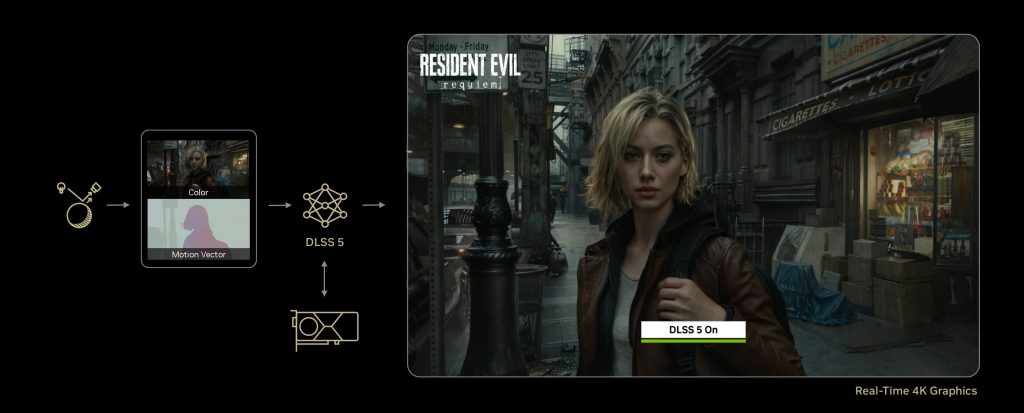
According to NVIDIA’s official announcement, DLSS 5 represents a major technological milestone. The key innovation lies in its expanded use of AI not only for upscaling but also for generating entire frames and enhancing scene reconstruction.
Key Advancements
1. AI Frame Generation at Scale
DLSS 5 builds on previous frame generation techniques by producing more frames between traditionally rendered ones. This significantly increases perceived frame rates, especially in demanding titles.
2. Neural Rendering Pipeline
Instead of relying purely on traditional rasterization and ray tracing, DLSS 5 introduces a more AI-centric rendering model. Neural networks play a larger role in reconstructing lighting, textures, and motion.
3. Improved Image Stability and Detail
NVIDIA claims that DLSS 5 reduces artifacts such as ghosting and flickering while delivering sharper details, even in fast-moving scenes.
4. Performance Gains Without Hardware Scaling
One of the most compelling aspects is that DLSS 5 can deliver substantial performance improvements without requiring proportional increases in GPU power.
The Backlash: Why Gamers Are Divided
Despite its technical achievements, DLSS 5 has not been universally embraced. The controversy largely stems from philosophical and practical concerns about the role of AI in rendering.
Core Criticisms
1. “Fake Frames” vs Real Rendering
Some gamers argue that AI-generated frames are not “real” frames, questioning whether performance gains are genuinely meaningful or artificially inflated.
2. Latency Concerns
Although NVIDIA has worked to minimize input lag, critics worry that generating additional frames could introduce latency inconsistencies, particularly in competitive gaming.
3. Loss of Native Rendering Purity
There is a growing sentiment among enthusiasts that reliance on AI diminishes the value of native resolution rendering and raw GPU power.
4. Developer Dependency
DLSS requires integration at the game level, meaning its effectiveness varies depending on developer implementation.
NVIDIA’s Response
Jensen Huang has publicly addressed the criticism, stating that gamers are “completely wrong” in dismissing DLSS advancements. His argument centers on a broader industry shift:
- Rendering is evolving from deterministic pipelines to AI-assisted processes
- The goal is not to replace traditional rendering but to enhance it
- AI-generated frames are still based on real data, motion vectors, and context
From NVIDIA’s perspective, DLSS represents progress—not compromise.

The Strategic Implication for the Industry
DLSS 5 is more than just a feature—it signals a structural change in how graphics technology will evolve.
1. AI as the Core of Rendering
The industry is moving toward hybrid and eventually AI-first rendering pipelines. DLSS 5 is an early manifestation of this shift.
2. Hardware vs Software Innovation
Historically, graphical improvements depended on hardware upgrades. DLSS shifts part of that burden to software and AI models, redefining performance scaling.
3. Competitive Landscape
Technologies like AMD’s FSR and Intel’s XeSS are direct responses to DLSS. However, NVIDIA maintains a lead due to its early investment in AI infrastructure.
4. Redefinition of “Performance”
Frame rate alone may no longer be the sole metric. Perceived smoothness, latency handling, and visual consistency will become equally important.
Are your product and brand truly aligned — or are key details getting lost?
Final Perspective
DLSS 5 represents both a technological breakthrough and a cultural inflection point in gaming. While the skepticism from parts of the community is understandable, it reflects a deeper transition—from traditional rendering philosophies to AI-augmented experiences.
The real question is not whether DLSS is “real” or “fake,” but whether it delivers a better overall experience. If it does—and early indicators suggest it might—then DLSS 5 could define the next era of graphics, much like ray tracing did before it.
In that sense, the controversy is not a weakness of DLSS—it is a signal that the industry is undergoing a fundamental transformation.